There’s a plant that grows insistently through the edges of things—along fences, through cracks, around whatever tries to contain it. Bindweed is usually unwelcome. It’s labelled invasive, disruptive, something to be removed before it takes hold. And yet, I’ve found myself returning to it, looking more closely, recognising something of myself within it.
Bindweed is native to the UK, and despite its reputation, it plays a quiet and important role in the ecosystem. Its pale, trumpet-like flowers open with a kind of softness that feels at odds with how aggressively the plant is treated. It feeds pollinators. It exists within a wider system of life. But most of the time, that isn’t what people see. What they see is something that spreads too far, holds on too tightly, refuses to grow where it’s told.
That tension is what drew me in.
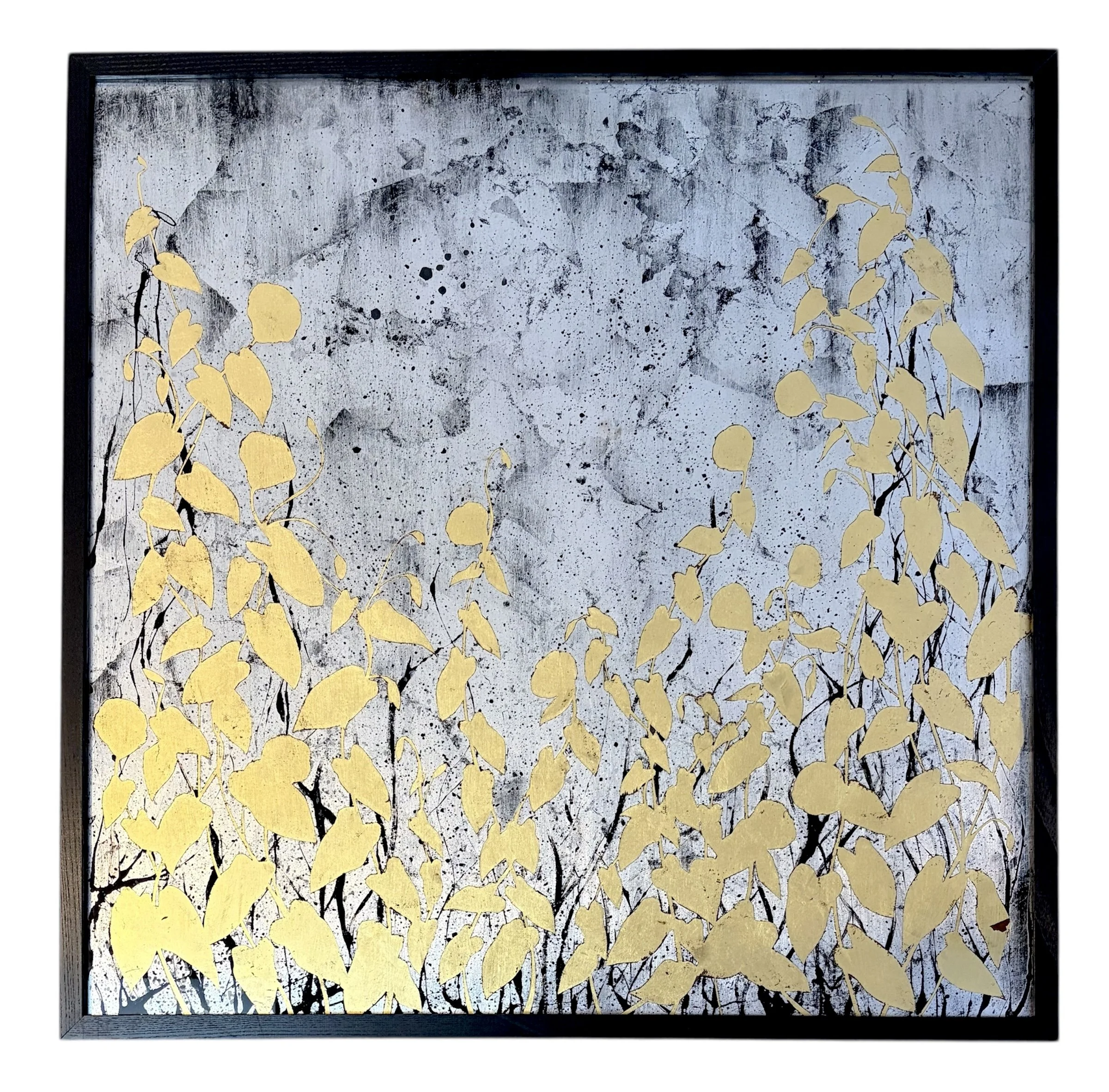
In this piece, I’ve used verre églomisé to capture the form of bindweed, gilding it in 24 carat gold and placing it against an industrial silver backing. The process itself felt important—working in reverse, building the image in layers that only fully resolve when viewed from the other side of the glass. There’s something about that inversion that mirrors the subject: what is hidden, what is revealed, what is misunderstood.
Gold is traditionally used to elevate, to sanctify, to declare worth. Here, it’s applied to something most people would instinctively discard. The silver backing, colder and more industrial, creates a kind of resistance—a reminder of the environments where nature has to push through, adapt, and survive. Together, the materials hold a contradiction: reverence and rejection, beauty and tension, fragility and endurance.
I didn’t set out to make a piece about bindweed as a botanical study. It became something more personal than that. The plant’s persistence—its refusal to disappear, its tendency to return no matter how often it’s pulled back—started to feel familiar. There are emotions that behave like that. Parts of ourselves that don’t sit neatly, that are inconvenient or difficult, that don’t conform to where they’re supposed to exist.
And yet, like bindweed, they have their own form of value.
There’s something quietly defiant in the way the plant grows. It doesn’t ask to be accepted. It doesn’t reshape itself to be more palatable. It simply continues—reaching, climbing, finding light wherever it can. I think that’s where the connection lies for me. Not in romanticising struggle, but in recognising a kind of resilience that isn’t loud or heroic. It’s persistent, subtle, and often overlooked.
This work is, in part, an attempt to shift perspective. To take something dismissed and hold it in a different light. To ask what happens when we stop seeing something as a problem to be removed, and instead see it as something to be understood.
Bindweed becomes a way of thinking about belonging—about what is allowed space, and what is pushed out. It asks questions about value: who decides it, and on what terms. And it reflects back something more internal, too—the parts of ourselves that might feel misplaced, but continue to exist anyway.
In the end, I don’t see bindweed as something to resolve or redefine. I see it as something to sit with. To observe. To recognise.
And maybe, in doing that, to recognise something of ourselves as well.
find ‘Calystegia Sepium’ on the Purchase page.